Polished floors · 11 March 2024
Honed versus polished — choosing a sheen
Sheen on a concrete floor is a grit sequence, not a catalogue finish. This piece sets honed matte against gloss, and deals with north-glass glare, slip, trowel marks, densifiers versus topical guards, and the way maintenance quietly raises the shine you thought you had locked.
By Tom Nguyen, Technical editor · Updated 1 December 2025
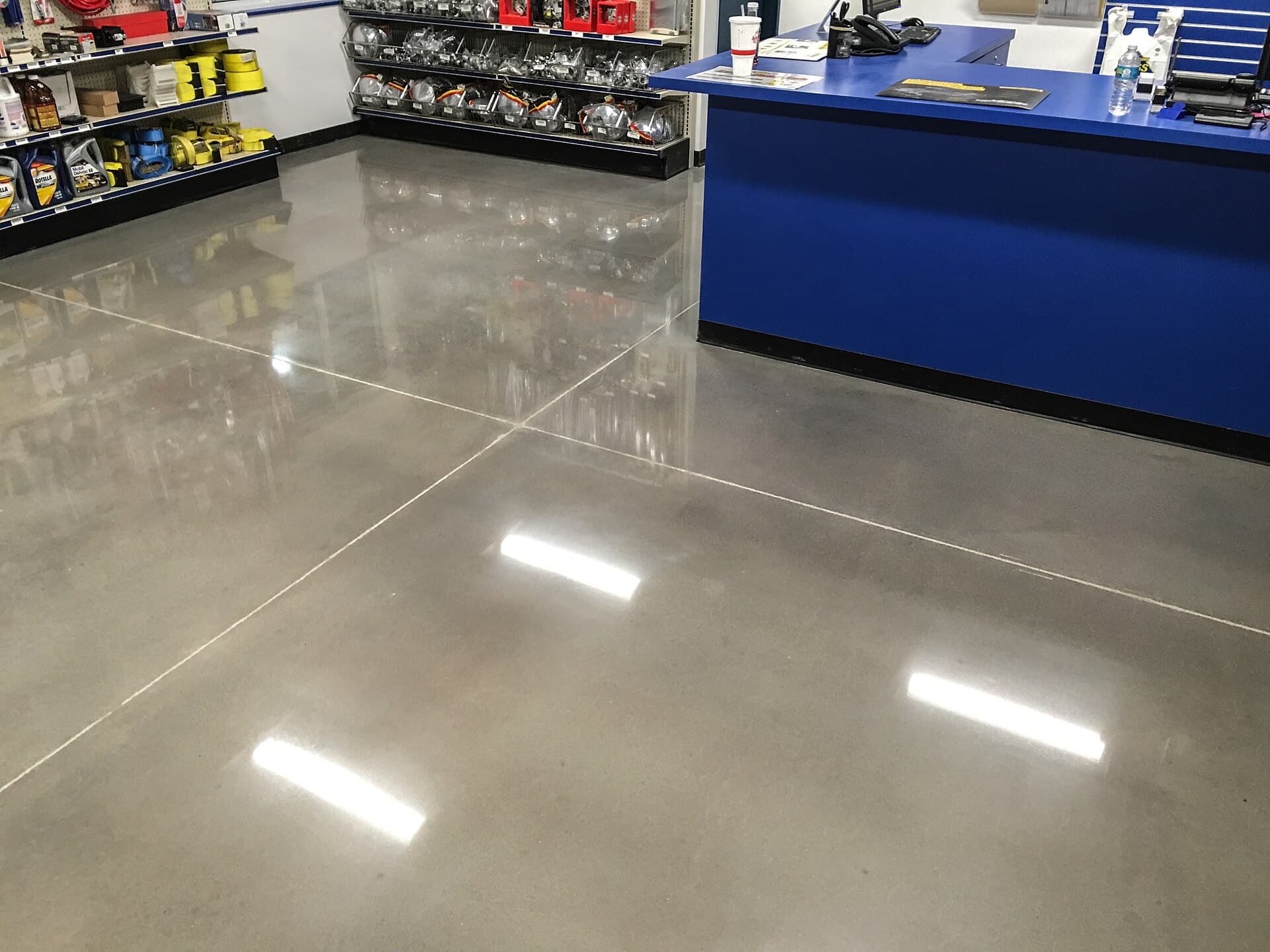
Sheen is the part of a polished floor that photographs well and specifies badly. Clients point at a picture and say they want that. Contractors hear a grit number. The slab, the light and the cleaner you buy six months later will all vote, and they do not vote the same way.
Honed and polished are not two materials. They are two places you can stop in the same sequence of cuts. The useful question is not which word sounds more expensive. It is how much reflection you can live with in an Australian room, and how much of the slab’s history you want the light to pick out.
Sheen is a process, not a product
A grind removes a thin layer, flattens micro-roughness and opens the paste. A hone continues that work with finer abrasives until the surface is smooth but still dull or softly satined. A polish takes the same surface further, until it begins to return an image. Densifier hardens the paste so those finer cuts have something to work. A topical guard, if used, sits on top and can add its own gloss.
If you treat the last step as a product — a coating that “is” the sheen — you will be surprised the first time it wears. Treat sheen as the depth of the last cut. The companion pieces on house floors and on grinding and densifiers sit under this one: exposure and chemistry decide what there is to shine.
The grit sequence
Trade sequences vary, but the logic is stable. Coarse metal-bond diamonds open the slab and determine how much cream, salt-and-pepper or aggregate you will see. Intermediate metals or hybrids flatten the field. Resin diamonds refine the surface. A typical house sequence might move through metals in the 30 to 80 range, then resins from about 100 through 200, 400, 800 and, if gloss is wanted, 1500 or 3000.
Honed work often stops around 200 to 400 grit after densifying. The floor is smooth to the hand, reads as matte or low satin, and does not throw a hard reflection. Polished work continues. Each finer resin tightens the surface and increases the return of light.
Skipping grits to save a day is how you get a floor that looks shiny in one patch and scratched in another. Each cut should remove the scratch pattern of the one before. That is tedious to write into a specification and expensive to skip.
The numbers are not a brand. They are a conversation with a particular machine, a particular slab hardness and a particular operator. A 400-grit stop on a dense, well-cured paste will not look like a 400-grit stop on a soft, dusty slab. The sample grind is where those numbers become a surface.
Honed matte and the case for stopping early
A hone is not an unfinished polish. It is a finished floor that has decided not to compete with the windows.
In houses, that is often the more intelligent stop. Matte and low satin hide the daily film of dust that Australian interiors collect. They are kinder to trowel marks you have chosen to keep in the cream. They photograph less dramatically and live more quietly. People sit on the floor with children and do not see their own silhouette in it.
Honed floors still need densifying. Smooth is not the same as soft. A hone without densifier will dust and mark. The point of stopping early is optical, not chemical.
A hone cleaned with a pH-neutral detergent and a dull pad stays a hone. A polish cleaned with a shine product becomes a different floor by the second winter.
Gloss, north glass and Australian light
Australian houses, especially those that follow the sun, put a great deal of light on the floor. North glass in Melbourne or Adelaide in winter is a low, hard rake. North and west glass in Brisbane or Perth in summer is a flood. A high-grit polish under that light can become a glare source, not a finish.
Stand in the room at 9am and at 3pm before you lock a gloss. Wet the sample. Look toward the window and away from it. If you need sunglasses to read a newspaper on the sofa, the sheen is too high for that glass, or the glass needs a treatment the floor should not be asked to compensate for.
Gloss also lengthens every defect. A slight wave from the power trowel, a cold joint in the paste, a patch of different hardness — all of them catch the sky. Some clients want that evidence. Most discover they do not, after the furniture is in and the afternoon sun has found the kitchen.
Retail and hospitality rooms with shopfront glass have the same problem at a larger scale. The hospitality piece is the right place for chair scrape and wine. The sheen decision is the same physics.
Slip, wet traffic and the mop
Dry, clean, densified concrete in a house is rarely a slip problem at either hone or polish. Wet concrete is a different floor. So is a film of olive oil from a kitchen, or the slurry a mop leaves if it is never wrung out.
A high polish can reduce micro-texture enough that a wet sock or a wet paw becomes a slide. A hone keeps more of that texture. Neither is a bathroom finish without a separate conversation about falls, drainage and a surface that was specified for wet bare feet.
If the brief includes a direct run from a pool, a dog wash or a laundry, do not take the floor to a mirror and then complain. Specify the wet use. A low satin with a guard that is maintained, or a change of finish at the wet threshold, is more honest than a slip-rated sticker on a glossy living room.
Trowel marks as evidence
Power trowels leave arcs, burns and a tightness in the paste that a cream grind will not hide. On a hone, those marks read as a quiet history. On a high polish they become graphic. That can be beautiful in a former workshop. In a new house it can look like a defect you paid to feature.
Decide, on the sample, whether you are keeping the trowel work. If you hate it, you may need to grind deeper — into salt-and-pepper — rather than polish harder. Polishing does not erase a burn. It varnishes it.
Hand-finished edges and stairs will never quite match a ride-on field. The sheen will drift. Light will find the difference. That is normal. It is also a reason not to chase a perfect mirror in a house full of returns and thresholds.
Densifier and topical guard
Densifier is a silicate solution — commonly lithium or sodium in Australian work — that reacts with free lime in the paste and hardens it. It is not a sealer in the paint sense. It does not sit as a thick film. It makes the last grits possible and reduces dusting.
A topical guard is a thin sacrificial layer. It can add stain resistance and a little extra sheen. It will wear in traffic lanes. It will need to be refreshed. If you use one, write the refresh into the maintenance note, and choose a sheen for the worn state, not the day-two shine.
Some floors are densified only. Some are densified and guarded. A gloss that depends entirely on the guard is a gloss you will lose. A gloss that comes from the resin sequence, with a guard as insurance, is more stable — until the cleaner starts adding its own film.
Do not specify a brand. Specify the role: densify the paste; optionally apply a breathable guard; do not substitute a commodity acrylic for either.
Sheen creep
Floors get shinier. Clients rarely notice the week it happens. They notice a year later, when the hone they chose has become a satin they did not.
The usual causes are ordinary. A “concrete shine” additive in the mop bucket. An auto-scrubber pad that is too aggressive, or too fine. A guard reapplied without a cut-back. A high-speed burnish that felt like a good idea after a party. Each pass lays down or tightens a film. The grit sequence you paid for is still underneath. The optical finish has moved.
If you wanted a hone, maintain it as a hone: pH-neutral cleaner, no polymer in the bucket, a pad that does not polish. If you wanted a gloss, accept that traffic lanes will dull and that a periodic re-polish or re-guard is part of owning the look. Sheen is not a setting you lock.
Choosing in the room, not on a board
Lock the exposure first, then the sheen. Look at both under the glass you actually have. Walk the sample wet. Sit on it. If the house faces north and the brief is a family room, the burden of proof is on gloss, not on the hone.
Write the stop point as a grit range and a visual standard from the sample, not as the word polished. That word has sold too many mirrors to rooms that needed a matte field. The floor will still be concrete. It will still need cleaning. It will simply stop competing with the sky.
Questions this piece answers
What is the difference between honed and polished concrete?
Honed work usually stops in the lower resin grits and reads as matte or satin. Polished work continues through finer resins and reflects more light. Both are ground and densified concrete. The difference is how far the sequence is taken, not a separate material.
Is a glossier floor more slippery?
When the floor is clean and dry, the difference is often smaller than people expect. When it is wet, or filmed with kitchen grease, a high polish can lose slip resistance faster than a hone. Specify the wet use, not only the dry photograph.
Why did our floor get shinier after a year of cleaning?
Many maintenance products leave a thin film. Auto-scrubbers and high-speed pads can also burnish a densified surface. That is sheen creep. If you wanted a hone, change the cleaner and the pad before you blame the original grind.
Keep reading in this hub
- In-slab heating under polished floors
Heating a slab and then polishing it is one system, not two trades who meet at handover. This piece compares hydronic and electric, cover to pipes, thermal mass from Hobart to Brisbane, cracking risk, when to polish, energy honesty, and the rugs that undo the heat.
- Polished concrete in retail and hospitality
A shop or dining room asks a polished slab to work after closing as well as in the photograph. This piece covers chair scrape, wine and oil, trading hours, acoustics, night cleaning, heritage fitouts, and the moments when vinyl or timber is the kinder floor.
- Grinding, densifiers and the maintenance myth
Polished concrete is sold as maintenance-free more often than it is explained. This piece covers what grinding does, how lithium and sodium densifiers work in principle, silica dust, pH-neutral cleaning, re-guarding, edge work and the patchy slabs that no chemistry will even out.