Polished floors · 18 June 2024
Grinding, densifiers and the maintenance myth
Polished concrete is sold as maintenance-free more often than it is explained. This piece covers what grinding does, how lithium and sodium densifiers work in principle, silica dust, pH-neutral cleaning, re-guarding, edge work and the patchy slabs that no chemistry will even out.
By James Calder, Materials editor · Updated 28 January 2026
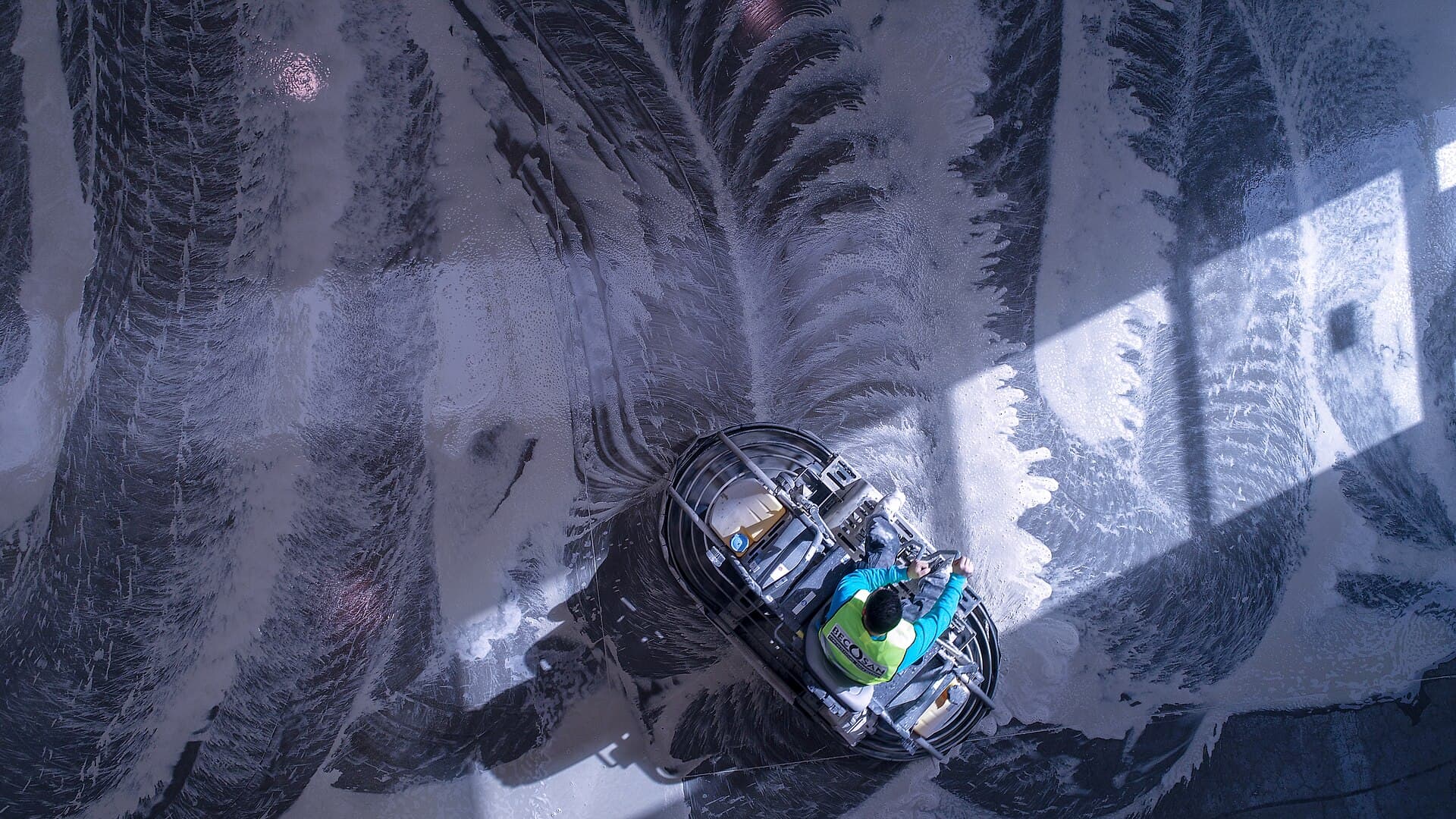
Polished concrete has a sales sentence that has done too much work: maintenance-free. The sentence is useful if you are comparing the floor to a timber that must be recoated, or a vinyl that must be replaced. It is misleading if you hear that you can ignore the slab.
What you actually buy is a ground, densified surface that dusts less, marks more slowly, and still lives in an Australian house or shop. Grit walks in. Wine sits. Edges get missed. The chemistry is real. So is the mop.
This is a materials and method problem as much as a finish problem. The grind only reveals the paste you poured or inherited. The densifier only reacts with what is there.
The myth of the forgotten floor
“Maintenance-free” in the trade usually means you are not waxing or stripping a topical system every year. That can be true of a well-densified floor with little or no guard. It does not mean the floor is inert. Paste still takes oil. Joints still collect dirt. Traffic lanes still burnish.
If a quotation uses the phrase, ask what the contractor will come back to do, and what you are expected to do weekly. Write both down. The gap between those lists is the myth.
What grinding actually does
Grinding is controlled abrasion. Metal-bond diamonds cut the surface; resin diamonds refine it. The first cuts set exposure — cream, salt-and-pepper, or a deeper reveal of stone. Later cuts set flatness at the scale of a shoe and, eventually, sheen. The sheen decision is downstream of this work. You cannot polish a field you have not flattened.
Each pass should remove the scratch pattern of the last. Dust extraction or a wet system should keep the cut clean. A dry grind without capture is not a finish method. It is a health and housekeeping failure.
Grinding also opens the paste so a densifier can move into it. A burnt, tight trowel skin can resist both the cut and the chemistry. That is why the first metal bond on a builder’s slab often looks like a fight. It is a fight with a skin that was never meant to be a face.
Dust, silica and the legal floor
Concrete grinding produces respirable crystalline silica. That is not a lifestyle footnote. It is a workplace hazard with Australian duties attached: elimination and isolation first, then engineering controls, then PPE. On a house site that means shrouds, vacuums rated for the dust, wet methods where they are specified, and no one dry-sweeping a plume into a hallway where children sleep.
The finished floor is not safe because the work looked tidy at handover. The work is safe if the dust was captured during the cut. Clients should expect plastic, negative air, and a crew that treats the grinder as a tool with a legal tail. If a price depends on an open-door dry grind, the price is incomplete.
Silica is also why “we will just knock it back with an angle grinder” is not a specification. Edge tools need the same extraction as the ride-on. Shortcuts show up as white dust on skirting.
Densifiers in principle
Densifiers are solutions of soluble silicates. In Australian work you will most often meet sodium or lithium systems, sometimes potassium or blends. They are not paints. They are not brands you need in a journal sentence. They are a reaction.
Cement paste contains calcium hydroxide. The silicate meets that lime and forms additional calcium silicate hydrate — the same family of binder that already holds the slab together. The surface becomes denser, less porous, harder to scratch and less inclined to dust. Finer resin cuts then have a tighter matrix to polish.
Sodium silicate is older, generally cheaper, and more likely to leave a residue that must be scrubbed off. It can whiten if it is over-applied or poorly removed. Lithium silicate is typically used at a lower solids load, penetrates usefully, and leaves less crust. Neither will rescue a lean, poorly cured paste. Neither is a stain-proof membrane.
Magnesium systems and proprietary blends exist. The principle does not change. You are offering the paste a reactant, not dressing it. Application is usually after an opening grind, with dwell time, then removal of residue, then the finer resins. Flooding a tight, unground floor and hoping for a factory look is not densifying. It is washing chemistry across a skin.
A topical guard, if used later, is a different layer. Do not confuse the two in the specification. Densify the paste. Optionally guard the surface. Do not substitute a hardware-store acrylic for either.
Patchy slabs
Patchiness is the most common complaint after a first house polish, and the least surprising if you watched the pour.
Power trowels do not apply even pressure. Curing is rarely even from the sunny door to the shaded hallway. A construction joint is a change in the paste. A rainy delay is a change in the mix. Decorative mix design can reduce that scatter on a new pour. It cannot rewrite an existing slab.
Grinding a patchy slab has two honest outcomes. You can stay shallow and accept the map of the trowel. Or you can cut deeper, hoping a more uniform salt-and-pepper will visually quiet the field. The second path uses more of the cover and still may not even the colour. Densifier will harden both the dark and the light. It will not dye them to match.
Test panels matter here more than anywhere. If the sample is a mottled cream, the house will be a mottled cream. Selling a uniform grey from that sample is a different job — overlay, stain, or a covering.
Edges, stairs and the last 100 millimetres
Ride-on grinders do the field. They do not do the room. Edges, returns, hearths, stair treads and the strip against a kitchen kickboard are hand work: smaller grinders, pads, patience. That work is slower and more expensive per square metre than the field, and it is where sheen and exposure drift.
A specification that prices only the field will look cheap and finish badly. Ask how edges will be cut, densified and guarded. Ask who protects the joinery. A densifier that creeps under a skirting and dries white is a stain you will own.
Stairs are their own trade. Each tread is a small slab with a nosing that wants to chip. Hand-honing a flight to match a polished downstairs field is possible. Matching it perfectly is a hope. Budget for the flight as a visible, labour-heavy element, not as leftover metres.
Cleaners, pH and the weekly habit
The weekly habit is simple and widely ignored. Sweep or dust-mop grit. Wash with a pH-neutral cleaner designed for densified concrete or for stone. Wring the mop. Do not leave a soup.
Acid cleaners etch paste. They will dull a polish and open a hone. Alkaline degreasers have a place on a kitchen spill, used briefly and rinsed. Vinegar, citrus and the various “natural” bottles that drift under sinks are not a maintenance plan. Nor are oil soaps that leave a film and then a dirt magnet.
Grit is the real enemy. Sand from a garden path will scratch a guard and, eventually, a densified surface. Mats at doors are part of the floor system. So is a decision about whether the dog comes in wet.
Spills belong to chemistry, not to panic. Wine, lemon and tomato are acidic. Oils are not. Both should be lifted promptly. A densified floor gives you time. It does not give you immunity.
Re-guarding
If a topical guard was part of the original system, it is sacrificial. Traffic lanes lose it first — the kettle path, the fridge door, the cafe pass. Re-guarding is a clean, a light abrasion or chemical strip of what remains, and a new thin film. It is not a second polish, and it should not be sold as one.
How often depends on use. A careful house might go years. A busy retail floor might need a calendar. Write the interval as a range and a visual trigger — when water no longer beads, or when the lane looks hungrier than the corners — not as a warranty slogan.
If there was no guard, you are maintaining a densified surface. Occasional professional re-densifying or a maintenance polish is possible. It is not compulsory on a schedule invented for a coating.
What maintenance-free actually means
It means you are not trapped in a wax cycle. It means the floor can take a long life of ordinary Australian use if you keep grit off it and stay away from acid. It means the chemistry of the paste is doing work that a thin film used to pretend to do.
It does not mean the slab is finished with human attention. Edges will need a hand. Patchiness will remain. The cleaner in the bucket will slowly change the sheen if you let it. A polished floor is a low-maintenance floor when it is specified and occupied honestly. It is a myth when it is sold as a surface you can forget.
Questions this piece answers
Is polished concrete maintenance-free?
No. A densified floor sheds less dust and marks more slowly than raw concrete, but it still needs regular pH-neutral cleaning, prompt spill management and periodic re-guarding if a topical was used. Maintenance-free usually means no waxing, not no work.
What is a densifier for?
A silicate densifier reacts with calcium hydroxide in the paste and hardens the surface so finer grinding is possible and dusting is reduced. It is not a paint and not a stain blocker on its own. Lithium and sodium systems differ in residue and handling, not in magic.
Why does our polished floor look patchy?
Most patchiness was in the slab before anyone ground it — different trowel pressure, curing, or mix. Grinding can reduce a skin, but it can also reveal harder and softer zones. Densifier will not dye those zones to match. A deeper cut or a different exposure is sometimes the only honest fix.
Keep reading in this hub
- In-slab heating under polished floors
Heating a slab and then polishing it is one system, not two trades who meet at handover. This piece compares hydronic and electric, cover to pipes, thermal mass from Hobart to Brisbane, cracking risk, when to polish, energy honesty, and the rugs that undo the heat.
- Polished concrete in retail and hospitality
A shop or dining room asks a polished slab to work after closing as well as in the photograph. This piece covers chair scrape, wine and oil, trading hours, acoustics, night cleaning, heritage fitouts, and the moments when vinyl or timber is the kinder floor.
- Honed versus polished — choosing a sheen
Sheen on a concrete floor is a grit sequence, not a catalogue finish. This piece sets honed matte against gloss, and deals with north-glass glare, slip, trowel marks, densifiers versus topical guards, and the way maintenance quietly raises the shine you thought you had locked.