Decorative concrete · 21 May 2024
Exposed aggregate driveways that last in Australian sun
Seeded stone and integral aggregate age differently in Adelaide heat, Perth UV and Brisbane storms. This piece covers local basalt, granite and river pebble, surface retarders, wash timing, sealer and hot-tyre marks, and the drainage falls that AS 3727.1 expects of a residential pavement that will still look like stone in twenty years.
By Priya Raman, Outdoor living editor · Updated 12 January 2026
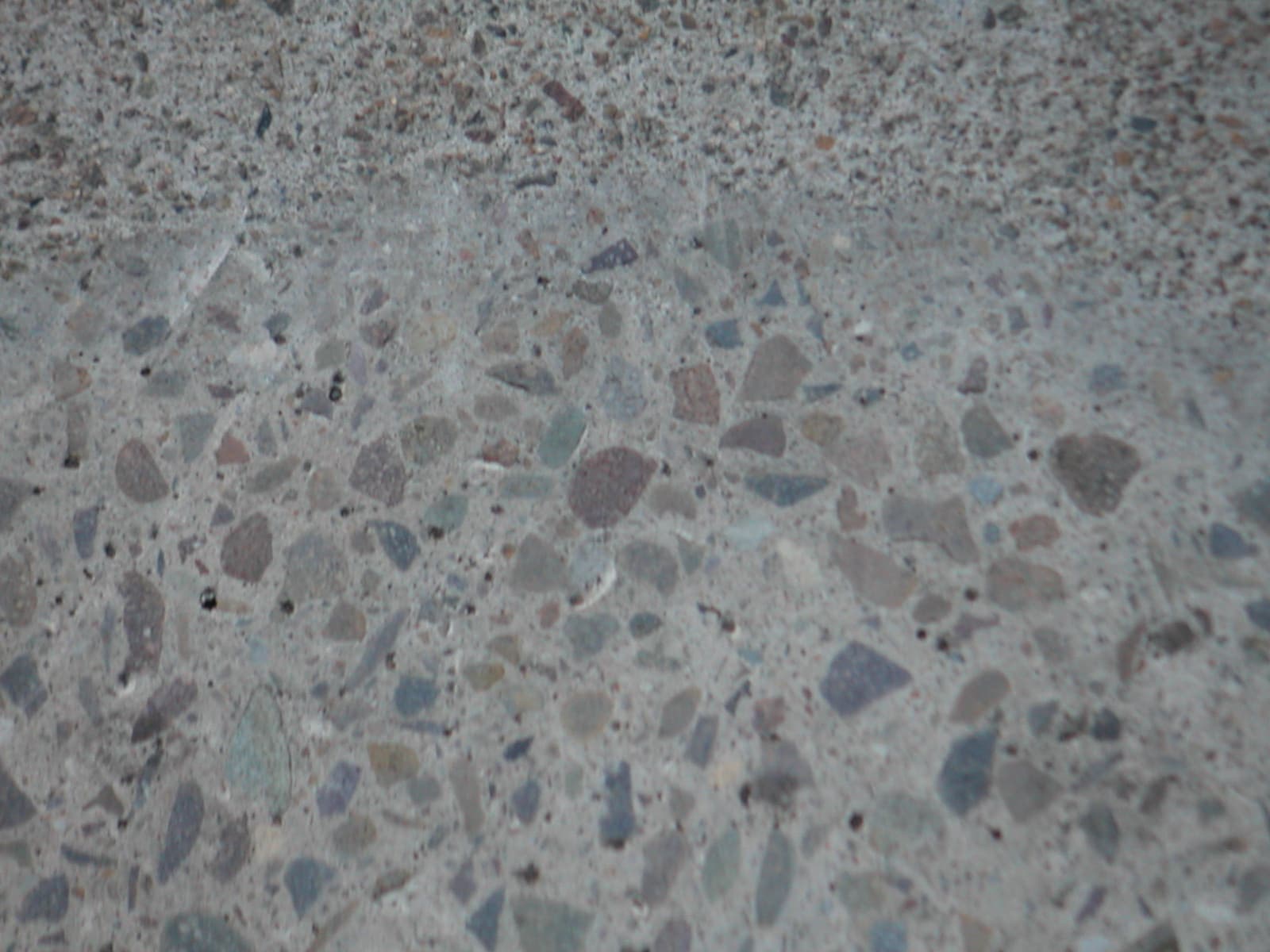
Exposed aggregate is the decorative concrete that most nearly admits what it is. You are looking at stone and paste, not at a print of stone. That honesty is why a well-made drive in Australian sun can still look like a decision twenty years on, when a stamp of the same vintage has become a date stamp. Honesty is not indestructibility. The sun, the wash, the sealer and the first hot tyre will all have a say.
The method is simple to describe and easy to miss. Concrete is placed, a surface retarder is applied, and at the right hour the paste is washed off so the aggregate stands proud. Get the hour wrong and you either ravel the surface or leave a cement skin that will dust and map. Get the stone wrong and you have imported a colour the local geology never offered.
Seed versus integral: two different slabs
Integral aggregate means the decorative stone is in the mix. Every saw cut, later grind and chip at the letterbox shows the same family of rock. The paste colour — grey, or an integral oxide — is the matrix those stones sit in. This is the more durable specification for a driveway that will be repaired, recut or worn by a turning circle.
Seeded aggregate is broadcast onto the plastic surface and worked in so the face is richer than the body. It is how you put a premium pebble on a workhorse mix, and how a lot of Australian display homes got their sparkle. The beauty is a crop. If the seed was thin or not fully embedded, traffic and a harsh wash leave bald paste. A replaced bay poured without the same seed will read as a different driveway.
Neither method is a moral category. Seed is honest when the client is told it is a face. Integral is honest when the stone is available in the volume the pour requires. What is not honest is a seed job sold as if the slab were stone all the way through.
Local stone is already a palette
The useful stones are the ones the truck can actually bring, and the ones that already sit in the street.
- Basalt, in its Victorian and New South Wales greys, sits calmly against brick, timber and a pale house. It can look sombre in full Perth light; it looks at home in Melbourne’s west and on the basalt plains it came from.
- Granite, from pinks and greys through to the salt-and-pepper faces familiar in New England and parts of Queensland, takes weather without fuss. A granite exposure in Adelaide heat will hold its contrast longer than a pale limestone blend.
- River pebble — the honey, russet and cream blends that defined a generation of Queensland and northern New South Wales drives — is the most obviously “decorative”, the most likely to look busy against a sharp contemporary house, and the most likely to show paste staining if the wash is uneven.
Perth work has its own conversation: pale coastal sands, high UV, and cream or white stone that can glare at midday and look dusty by the dry end of summer. A slightly darker granite or a local lateritic pebble often ages with more composure than a bleached mix chosen under fluorescent light. Brisbane and the coastal strip north of it add storm water, leaf tannin and wet-season algae that love a north-facing, poorly drained bay. The stone must take a pressure clean without raveling.
Adelaide combines dry heat, UV and, on many inner-north and foothills sites, reactive clay. The exposure can be perfect and the drive still step at the joints if the pavement was detailed as a pretty lid on moving ground. Stone choice does not repeal the clay problem. It only decides what the moving lid will look like. Match the stone to the geology you can see from the front gate. Match it to a brochure from another state and the house is wearing a souvenir.
Retarder and wash: the hour that makes the face
Surface retarders slow the set of the paste at the top few millimetres so the stone can be revealed without washing out the slab. They are applied after finishing, evenly, and then protected from footmarks and from rain. The wash — water, sometimes with a light mechanical assist — happens when the paste has lost its sheen and the stone will stand without coming out in your hand.
That hour moves. A slab poured at 7 am on a still April morning in Hobart and a slab poured at 11 am in February on a western courtyard in Townsville are not on the same clock. Wind strips surface moisture. A dark basaltic mix sets faster at the face than a pale mix beside it. If the crew washes to a product-sheet time rather than a test patch on the actual pour, some bays will be over-exposed and some will keep a cement veil.
Practical hold points, none of them glamorous:
- Apply retarder at the coverage stated for the day’s temperature, not “until it looks wet”.
- Keep a test area at the edge of the first bay and wash that first.
- Wash to a consistent stone reveal — typically a third to a half of the coarse particle proud — not to a photograph from a different job.
- Do not leave retarder overnight on a slab you cannot protect from dew or a tropical shower.
- Cure after the wash. An exposed face still needs water or a curing compound that will not stain the stone. The first seventy-two hours remain the hours that AS 3600-minded work treats as structural, not cosmetic.
An uneven reveal is the defect clients describe as “patchy colour”. Often the stone is fine and the paste depth is not.
Sun, sealer and the parked car
Australian sun works on an exposed drive in three ways. It fades any organic tint in the paste and in a film sealer. It heats the surface until a dark basalt is uncomfortable to stand on. And it cooks the interface between a hot tyre and a sealer film.
Film-forming acrylics, especially solvent-borne “wet look” coats, saturate the stone and make the handover photograph. They also soften under a car that has driven two hours up the Bruce Highway and then sat in a Brisbane driveway at 3 pm. The print is often a blush in the film, not a stain in the concrete. Recoating hides it for a while and then builds a skin that peels in the wheel paths.
Penetrating treatments — silanes, siloxanes, some silicate densifiers — change the look less and the tyre argument more gently. They will not make a pale pebble immune to oil, but they do not create a thermoplastic layer for the sun to work on. The broader chemistry sits in the journal’s piece on sealers and the Australian UV problem. A wet-look film can also worsen slip under AS 4586. If you need the stone wet forever, you are volunteering for a recoat cycle.
Dark oxide under a pale pebble can look sophisticated and still store heat. Sample panels, left in the actual sun for weeks, are cheaper than a driveway you resent.
Falls are not a decorative extra
AS 3727.1 is the residential pavement standard that owners never read and drives always reveal. Water has to leave the surface. A fall in the order of 1:100 is the familiar starting point; less than that and you are designing a pond with stone in it. Ponding leaves mineral rings, feeds algae on the Brisbane coast, concentrates dirt at the garage door, and makes a sealer blush.
Falls have to be designed around the house: the slab level at the door, the street invert, the neighbour’s crossover, the grate that is never quite where the water wants to go. Decorative stone does not excuse a flat bay. Every pebble is a little dam. An exposed drive without a proper edge beam on a clay site will curl and fray, and the first stones to leave will be the ones at the perimeter. The beautiful face is attached to a pavement. Specify both.
What lasts, in three cities
An Adelaide foothills drive in local quartzite or a tough granite, integral, lightly sealed, jointed for clay and falling to the street, will still look like the hills it came from. A Perth coastal drive in a mid-toned granite, detailed for glare and for sand tracked off the verge, will outlast a cream pebble chosen to match a limestone wall that then went to chalk. A Brisbane inner-suburban drive in a river pebble already used on the same street, washed evenly, given falls that work in a February storm, and not filmed to a gloss, will take tannin and a pressure clean and still be itself.
What does not last is the drive specified as a picture: mixed stone from nowhere, seeded thin, washed in a rush, sealed to a wet look, laid almost flat, and asked to imitate a stamp. Exposed aggregate is already a pattern. It does not need a second one. If the brief is grip, longevity and a face that belongs to the block, this remains one of the best decorative methods we have. If the brief is a photograph of someone else’s pebble, pour a sample, leave it in the sun, park a car on it, and only then book the truck.
Questions this piece answers
Seeded stone or integral aggregate — which lasts longer?
Integral aggregate is present through the slab, so wear and a later grind still show stone. Seeded stone is a surface crop; if the paste wears or a bay is recut, the body may not match. Seeding remains useful for a premium face on a standard mix, provided the seed is well embedded and the client accepts that repairs will be visible.
Why do some exposed drives go patchy after the wash?
The retarder was not applied evenly, or the wash was early in one bay and late in another. Sun, wind and a hot slab shorten the window. Wash to a sample, not to a clock. A bay that was left too long will need a light abrasive to reveal stone; a bay washed too soon will ravel.
Will a sealer stop hot-tyre marks?
Not reliably, and some film sealers make the marks worse by softening under a parked car in January. A penetrating treatment reduces staining from oil and tannin more than it prevents tyre print. Shade, a paler stone and a mix that is allowed to harden before heavy parking do more than another coat of acrylic.
Keep reading in this hub
- When concrete should not imitate stone or timber
Faux slate and printed timber ask concrete to impersonate a material it will outlast. This essay argues for honest grey and oxide in the lineage of Australian modernism, names when a stamp becomes kitsch, and sets out the few cases — access, heritage streetscape — where imitation still earns its keep.
- Stencil and overlay systems for tired slabs
An overlay is honest when the host slab can still carry load and moisture. This article explains bond, polymer overlays versus microtoppings, stencil colour, why movement joints must continue through the new face, typical delamination and mapping cracks, and when the only kind repair is to rip the slab out.
- Stamped and patterned concrete that earns its keep
Stamp mats, stencils and antique release can make a driveway look finished on day one and tired by year eight. This article covers joint layout versus pattern, repairability, slip under AS 4586, fading release colour, and the moment a suburban Australian stamp becomes a period piece rather than a finish.