Decorative concrete · 3 April 2024
Stamped and patterned concrete that earns its keep
Stamp mats, stencils and antique release can make a driveway look finished on day one and tired by year eight. This article covers joint layout versus pattern, repairability, slip under AS 4586, fading release colour, and the moment a suburban Australian stamp becomes a period piece rather than a finish.
By Tom Nguyen, Technical editor · Updated 18 November 2025
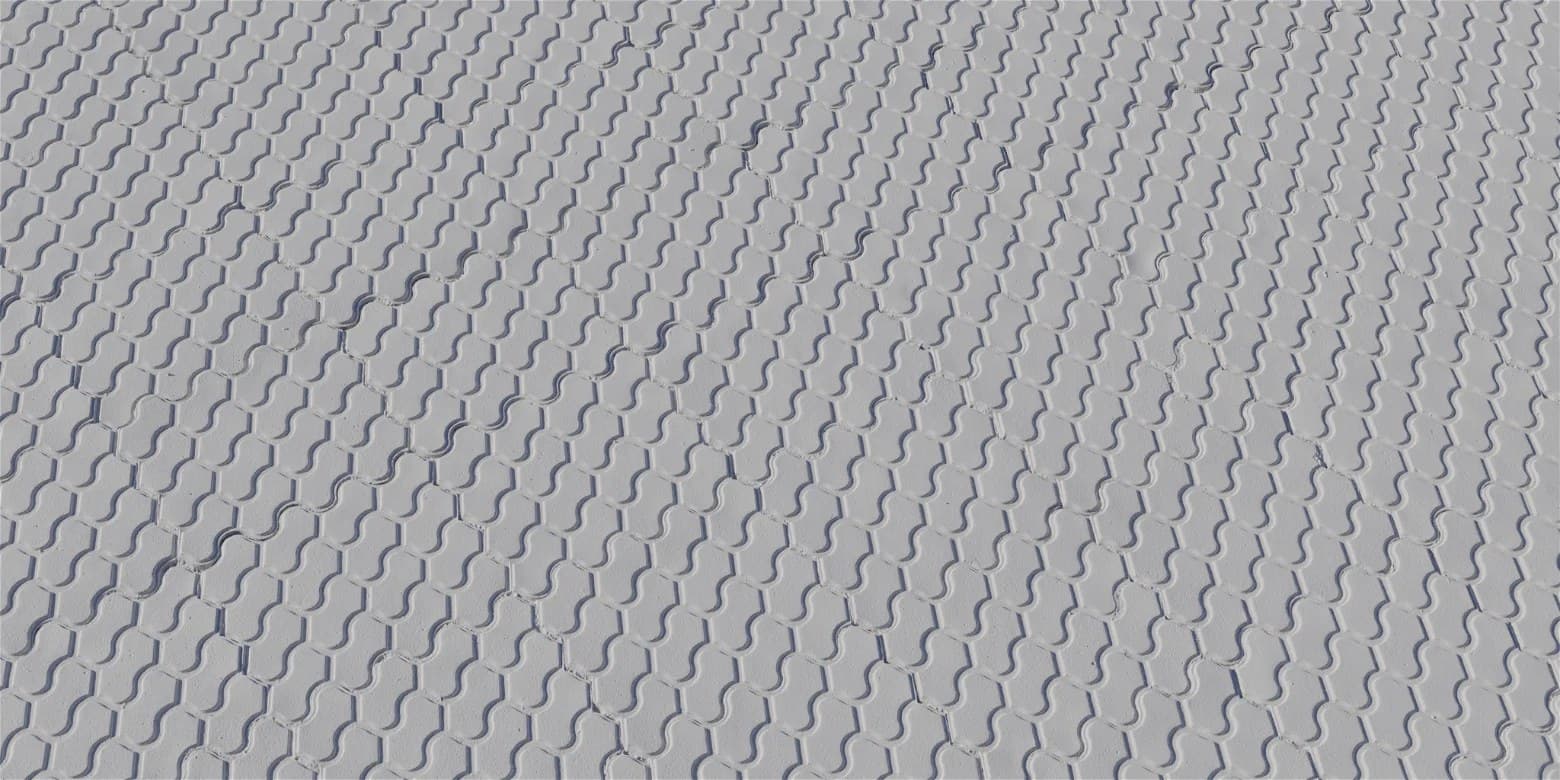
A stamped driveway is a bet that a pattern pressed into plastic concrete will still look like a decision in a decade, not like a fashion the street has moved past. Plenty of Australian suburban work from the late 1990s and 2000s lost that bet. The ashlar slate, the running-bond brick, the boardwalk timber photographed well for the first summer. Then the antique release faded, the sealer ambered, the control joints cut across the fake pavers at unconvinced angles, and the house was left with a surface that could be neither repaired quietly nor ignored. That history is not an argument against pattern. It is an argument against pattern that was never asked to do any work beyond the handover photograph.
What the mat is actually doing
A stamp mat is a skin. It is pressed into concrete that has been coloured — usually with a dry shake, sometimes over an integral oxide — after a powdered or liquid release has been applied so the mat will lift. The impression is only as deep as the mat and the timing allow. Too early and the surface tears. Too late and the pattern is a rumour. The crew is working in a window measured in minutes, shorter in Darwin build-up weather than on a mild Sydney autumn afternoon.
A stencil is a different instrument. Paper or plastic is laid on the plastic surface, colour hardener is shaken through, and the stencil is lifted to leave grout lines. The face is flatter than a deep stamp; the “joints” are colour, not relief. Stencil is often quicker, cheaper, and even less repairable, because the grout line is a dusting of pigment rather than a groove you could recut. The journal’s piece on stencil and overlay systems for tired slabs deals with stencil as a retrofit. On a new pour the same test applies: if the pattern cannot be replaced in a bay, it is decoration you will have to live with when it fails.
Liquid release and powdered antique release are not colour in the sense that oxide is colour. They are a parting medium that happens to stain the low points. Clients see the mottled brown and think they have bought a through-body hue. They have bought a residue.
Joints are structure; the pattern is not
This is the mistake that dates a stamp faster than UV. Concrete wants sawn or tooled joints at spacings that follow thickness, reinforcement and restraint — the discipline AS 3600 frames for structure and that AS 3727.1 translates, for a house pavement, into practical bay sizes, falls and edge support. A stamp pattern wants to look like pavers or boards. Those two geometries coincide only if someone draws them together before the pour.
When they are not drawn together you get the familiar suburban diagram: fake slate units running toward the garage, interrupted by a straight saw cut that belongs to the slab and not to the fiction. Once the eye has learned that cut, it cannot unlearn it. The pattern becomes a print on a structural object, which is what it always was.
A patterned pavement that earns its keep does one of the following:
- accepts the joints as the primary drawing and lets the stamp be a texture inside each bay
- aligns the stamp module to the joint grid so that a saw cut falls in a “grout” line
- abandons imitation units altogether and uses a texture mat — a broken stone, a fine crease, a light skin — that does not pretend to be laid pieces
The third option is the one Australian streets could use more of. Texture is not the same as impersonation. A mat that roughens the surface for grip and shadow can sit inside a modern house without quoting a European piazza.
The suburban driveway is a hard brief
Most stamped concrete in this country is not a hotel courtyard. It is a six-metre-wide driveway on a quarter-acre or a townhouse gun-barrel, taking a hot tyre, a bin, a basketball and the occasional skip. A north-facing drive in western Sydney or the Adelaide plains will cook a dark stamp and bleach a release powder. A shaded inner-Melbourne drive on reactive clay will move, and every movement will telegraph through a thin decorative skin. Coastal work from Newcastle to the Gold Coast combines salt, irrigation overspray and UV that eats the sealer first and the release second.
AS 3727.1 still wants falls that drain, a thickness and subgrade that carry the vehicle, and joints that control cracking. None of those requirements is relaxed because the surface looks like stone. A ponding bay on a stamped drive is a ponding bay with a pattern drowning in it.
Slip is the other quiet failure. Deep slate textures can be surprisingly polished once a film sealer has filled the microtexture. Timber-board stamps, with long grain ridges running down the fall, can be worse still when wet. AS 4586 classifies new pedestrian surfaces; it is not a lifestyle brochure. If the driveway is also the path to the front door — as it is on thousands of Australian lots — texture and sealer have to be chosen as a pair and checked on a sample sealed the way the job will be sealed. A display slab under a trade-show marquee is not that sample.
A stamp that cannot be walked on in a July frost in Ballarat, or after a January storm in Cairns, is not a finish. It is a hazard with a pattern.
Colour antique release is a fading argument
The most common complaint, five to eight years in, is that the drive has “lost its colour”. What it has usually lost is the antique release. Traffic takes the highs; UV and detergent take the rest. The base colour — a dry shake, if that is all there was — then wears at the gate. The result is a mottled grey-brown that no longer matches the porch it was chosen to accompany.
Coloured concrete for Australian homes sets out why integral oxide is the colour that survives this sequence. On a stamp job specify both: oxide through the mix so wear reveals a cousin of the face, and a shake plus release only as the first weather layer. When the release is gone, the drive should still be a colour, not a confession.
Sealer choice changes the fade rate and the slip class together. A solvent acrylic will saturate the release and make the first year look like the brochure. It will also need recoating, and each recoat can darken, gloss and eventually peel in the wheel paths. A penetrating treatment will look drier on day one and age more evenly. The longer chemistry sits in the journal’s note on sealers, coatings and the Australian UV problem. For stamp work the rule is simple: do not buy saturation you cannot maintain.
Repair is a bay, or it is a mess
Stamped concrete is unkind to the patch. The mat used in 2014 may be worn, discontinued or in another state. The release colour will not be quite the same. Adjacent bays have aged. A clever finisher can get close on a small spall. A car-width replacement in the middle of a gun-barrel drive will read as an insert for the life of the slab.
Joint the drive so that a bay is a replaceable object. Choose a texture a competent crew can approximate without the original skin. Record the oxide dose, the shake, the release and the sealer on a sheet that outlives the builder’s email account. If invisible repair is essential — a tight inner-city court, a heritage streetscape, a client who will not accept a visible splice — stamp is the wrong method. Exposed aggregate, a quiet oxide or a honed slab will take a bay replacement with more dignity.
When the stamp has become a period piece
There is a moment, familiar on any Australian suburban walk, when a patterned drive stops being a material and starts being a date. Ashlar slate in terracotta and charcoal says 2004. Herringbone brick stamp says the same decade in a different estate. Faux timber boards say a later attempt to warm a house that did not want to be grey. They become kitsch when the house has been renovated around them, or when the pattern quotes a material the house would never have used — a Federation cottage with a Tuscan slate court, a sharp contemporary box with a boardwalk drive that fooled no one even when new.
The aesthetic case for not impersonating stone or timber is made elsewhere in this journal. The technical case belongs here: a dated stamp is hard to undo. You cannot un-press a mat. You can overlay, with all the bond and joint obligations that implies, or you can rip out. Both cost more than specifying a quieter texture in the first place.
Pattern earns its keep when it does a job the grey slab cannot: breaking a large face into shadow, adding grip without a coarse broom, relating a court to a garden without laying thousands of pavers that will need resetting on clay. It does not earn its keep as a substitute for stone that was never in the budget. Australian houses take pattern best when the joints are honest, the colour is in the slab, the slip has been thought about, and the mat is a texture rather than a disguise.
Questions this piece answers
Do stamped driveways become slippery?
They can. A tight slate or timber texture plus a film-forming sealer often reduces microtexture. AS 4586 is the classification that matters for a new pedestrian surface; a residential pavement should also meet the falls and finish intent of AS 3727.1. Specify the texture and the sealer together, and test a sample, not a brochure.
Why does the brown antique colour disappear first?
Antique release is a pigmented powder sitting in the low points of the stamp. Traffic, UV and cleaning remove it from the high points first, then from the joints. What remains is the base colour — often a dry shake — wearing thin. Integral oxide in the body of the slab is the colour that will still be there when the release is gone.
Can a stamped bay be repaired invisibly?
Rarely. Matching the mat, the release residue, the sealer amber and eight years of fade in one patch is a craft problem with no reliable industrial answer. Design joints so a bay can be replaced as a bay. If invisible repair is the brief, stamp is the wrong method.
Keep reading in this hub
- When concrete should not imitate stone or timber
Faux slate and printed timber ask concrete to impersonate a material it will outlast. This essay argues for honest grey and oxide in the lineage of Australian modernism, names when a stamp becomes kitsch, and sets out the few cases — access, heritage streetscape — where imitation still earns its keep.
- Stencil and overlay systems for tired slabs
An overlay is honest when the host slab can still carry load and moisture. This article explains bond, polymer overlays versus microtoppings, stencil colour, why movement joints must continue through the new face, typical delamination and mapping cracks, and when the only kind repair is to rip the slab out.
- Exposed aggregate driveways that last in Australian sun
Seeded stone and integral aggregate age differently in Adelaide heat, Perth UV and Brisbane storms. This piece covers local basalt, granite and river pebble, surface retarders, wash timing, sealer and hot-tyre marks, and the drainage falls that AS 3727.1 expects of a residential pavement that will still look like stone in twenty years.