Materials and method · 31 July 2024
Repairing decorative concrete without making it worse
A decorative repair that announces itself is often worse than the original scar. This piece covers colour-match limits, crack types, spalls, overlay versus patch, and the case for documenting the damage before anyone touches the face — then leaving some of it alone.
By Priya Raman, Outdoor living editor · Updated 20 January 2026
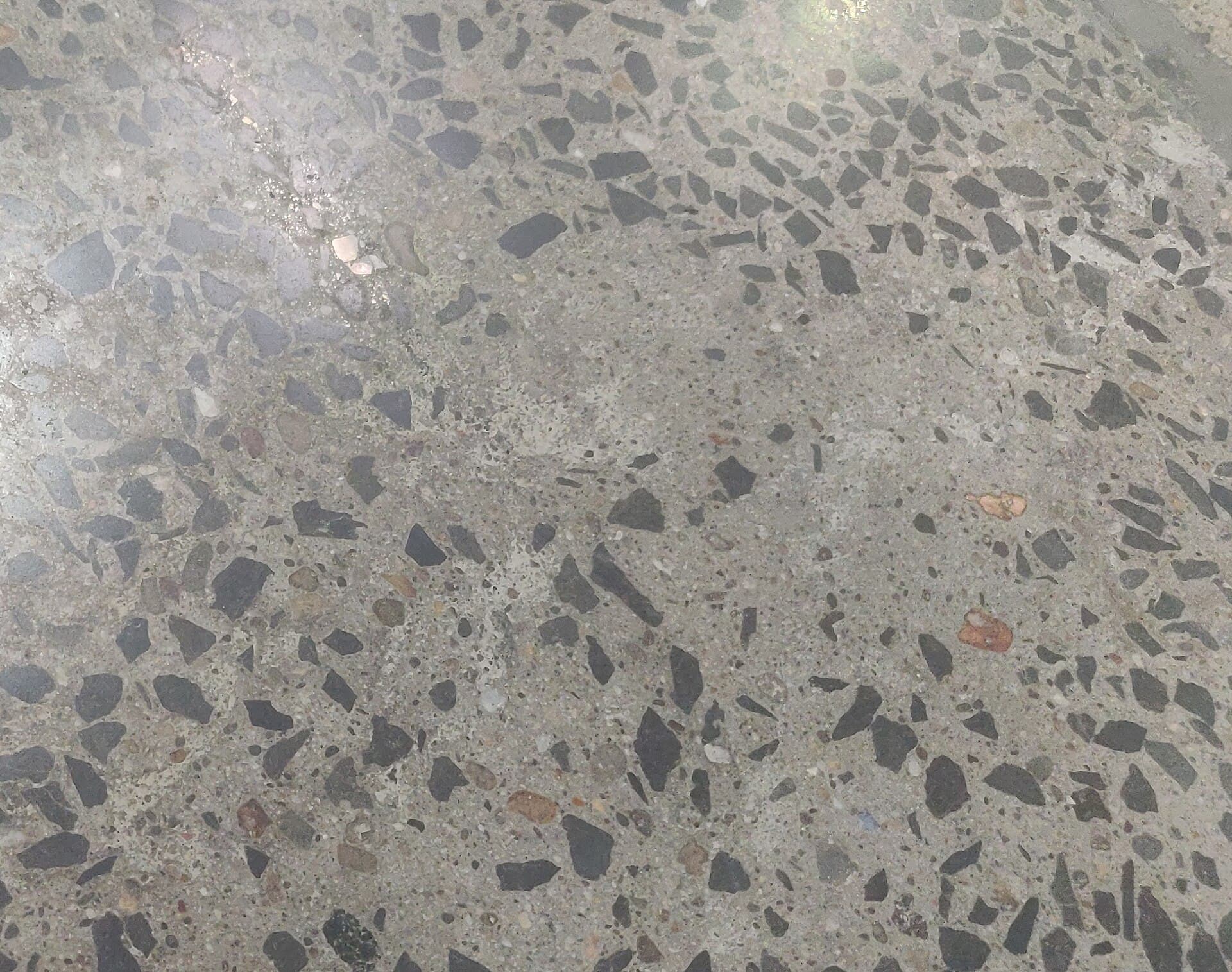
Decorative concrete fails in public. A crack in a hidden footing is an engineer’s note. A crack across a living room or a courtyard is a daily argument. The instinct is to make it disappear. The instinct is how a small scar becomes a large, slightly wrong rectangle that the eye finds from the gate.
This journal’s repair ethic is conservative. Diagnose the damage. Document it. Repair what threatens durability or safety. Leave some of what is only a record of the pour. A patch that does not match is not honesty. It is a second, louder defect.
Colour match is not a service you can buy
Concrete colour is a history: cement, sand, oxide, water, cure, sealer, traffic and sun. A repair is a new history poured into a hole. Even if the bag is the same and the oxide is weighed, the surrounding slab has carbonated, worn and taken a sealer that the patch has not. Wet, the two can look close. Dry, in afternoon light, they often do not.
Accept that before anyone opens a drum.
- A darker patch on a pale slab will read as a damp mark forever
- A paler patch will read as a repair, which it is
- A patch that is “close enough” on a cloudy day will not be close enough on a north courtyard at 3pm
- Feathering a thin film of tinted slurry over a wide area usually creates a tide mark
The useful aim is quietness, not invisibility. Match the texture. Recess the repair slightly rather than leaving a proud pancake. Use a repair mortar that belongs to concrete, not a flexible goo that shines. Then seal the patch and the surrounding field in one campaign so at least the sheen is related.
If invisibility is the only acceptable outcome, you are not commissioning a repair. You are commissioning a new finish — a grind, a sealer change, or an overlay — and you should budget and sample it as new work.
The best decorative repair is the one you decide not to do after you have understood the crack.
Crack types, which are not one problem
Shrinkage, movement and reflection
Calling every line a crack is how the wrong material goes into the right hole.
Plastic-shrinkage cracks form while the slab is still young, often in wind. They are shallow, fine, sometimes parallel. They collect dirt. They rarely threaten the structure. Filling them with a rigid paste can look worse than leaving them, or than a careful, low-contrast dust that is worked in and sealed.
Drying-shrinkage cracks come later, as the slab loses moisture. They often find joints you should have put in, or re-entrant corners you did not ease. If they are stable and hairline, they are a joint the slab chose. If they are widening, stepped, or associated with a lip, the soil or the slab has a larger problem.
Structural or settlement cracks — a step in the surface, a crack that continues through an edge, a door that suddenly binds — are not decorative events. They want an engineer, especially on clay. Filling them with a colour-matched mortar is cosmetic theatre over movement.
Reflection cracks appear when a topping or overlay sits on a slab that is still moving at its own joints. The overlay did not fail morally. It failed to include the joint.
Repair follows type. A stable hairline can be left or lightly filled. A moving crack needs a joint or an engineer. A crack that is a trip needs grinding or reconstruction, not pigment.
Spalls, chips and the edge that always goes first
Spalls are pieces that have left. Impact on a nosing, rust jacking from a bar that was too close to the face, freeze in an alpine planter, a rusty service penetration — the hole is the symptom.
Cut back to sound concrete. Square or dovetail the edge so the repair has a thickness, not a feather that will pop. Clean. Replace or treat steel if steel is the cause; otherwise you are filling a hole above a continuing rust bloom. Then place a repair material that can take the exposure. On a decorative face, the last millimetres are the visible ones. A strong, grey structural repair with a thin decorative skin over it will telegraph as soon as the skin wears.
External corners — stair nosings, bench edges, the arris of a wall — will chip again if the geometry stays razor-sharp in a family house. A slight radius on the repair is not a loss of purity. It is how the corner stays.
Rust stains around a spall are a separate honesty. They can be lightened; they rarely vanish. If the steel is still active, the stain will return. Fix the cover and the moisture path before you argue about bleach.
Overlay versus patch
A patch is a local ethical decision. An overlay is a new decorative job on an old slab.
Overlays earn their keep when the surface is generally tired: widespread crazing, a sealer that cannot be recovered, a colour you no longer want, a slab that is sound underneath. They fail when the substrate is moving, damp, oily, or cracked in a pattern the overlay is expected to hide. Hiding is not a structural strategy.
An overlay needs:
- a slab you have tested for soundness and moisture
- joints that match the joints below, or a system that can take the movement
- a sample on the actual floor, not on a board in a warehouse
- a sealer and maintenance story of its own
- an admission that you now have two materials, one on top of the other
A single dramatic crack with a sound field around it is usually a patch or a designed inlay — a strip of another material, a brass or a shadow gap — rather than a topping of the whole room. Inlays are honest. They say the crack was here. Overlays that claim the crack is gone will show it again in a dry summer.
When to live with the scar
Some marks are the building. A pour join on a wall that was drawn as a join. A hairline on a courtyard that opened in the first summer and has not moved since. A faint rust bloom from a tie hole you chose to leave. Chasing these with paste is how a calm surface becomes busy.
Live with a scar when:
- it is stable
- it is not a trip, a leak or a corrosion cell
- the repair would be larger or louder than the defect
- the rest of the architecture can carry a little history
This is not neglect. It is editing. Houses that try to look unpoured tend to look anxious.
Documentation before anyone touches the face
Photograph the damage dry and wet, in morning and afternoon light, with a scale — a coin, a tape. Note when it appeared, whether it has grown, and what sits under it: clay, a drain, a first-floor timber joist, a service. Keep the original mix docket if you have it. If you do not, say so; the repairer is then guessing the paste.
Write the brief as a commissioning problem, not as a plea to make it new.
- What must be structurally or hygienically fixed
- What may be left
- What sample will be approved, and that colour match is not the acceptance test
- Who owns movement if the crack is not stable
Do not let a well-meaning weekend slurry become the first “repair” that then has to be ground out. Decorative concrete is patient about some injuries and unforgiving about the cover-up. The materials lesson is the same as the architectural one: decide what the face is allowed to be, then stop.
Questions this piece answers
Can a patch be colour-matched to existing decorative concrete?
Not reliably. A new paste has a different age, moisture and oxide history from the slab around it. A good repair is structurally sound and visually quiet. A perfect match is a promise this journal does not make.
When is an overlay better than a patch?
When the defects are many, shallow and widespread — a tired surface rather than a single spall. An overlay is a new finish with its own joints and maintenance. It is not a disappearing trick.
Should I repair every crack in a decorative slab?
No. Hairline shrinkage cracks that are stable are often better left, perhaps lightly filled if they collect dirt. A crack that is moving, leaking or a trip needs an engineer or a builder, not only a colour conversation.
Keep reading in this hub
- Briefing a concrete contractor — samples and hold points
Good concrete is commissioned, not hoped for. This essay sets out a written brief, sample panels, hold points, weather call-offs and payment stages, plus the photographs this journal expects a reader to keep before anyone books a truck for the job.
- Low-carbon mixes, recycled aggregate and SCMs
A lower-carbon mix is a specification, not a colour. This essay looks at embodied carbon, the real availability of fly ash and slag in Australia, the limits of recycled aggregate on a decorative face, and the questions that separate a plant conversation from greenwash.
- AS 3600, AS 3727 and what homeowners actually need to know
Two Australian Standards govern most house concrete, and they are not interchangeable. This essay translates AS 3600 and AS 3727.1 into questions a homeowner can ask — certificates, engineers, decorative extras versus structural minimums — without pretending a journal article is legal advice.